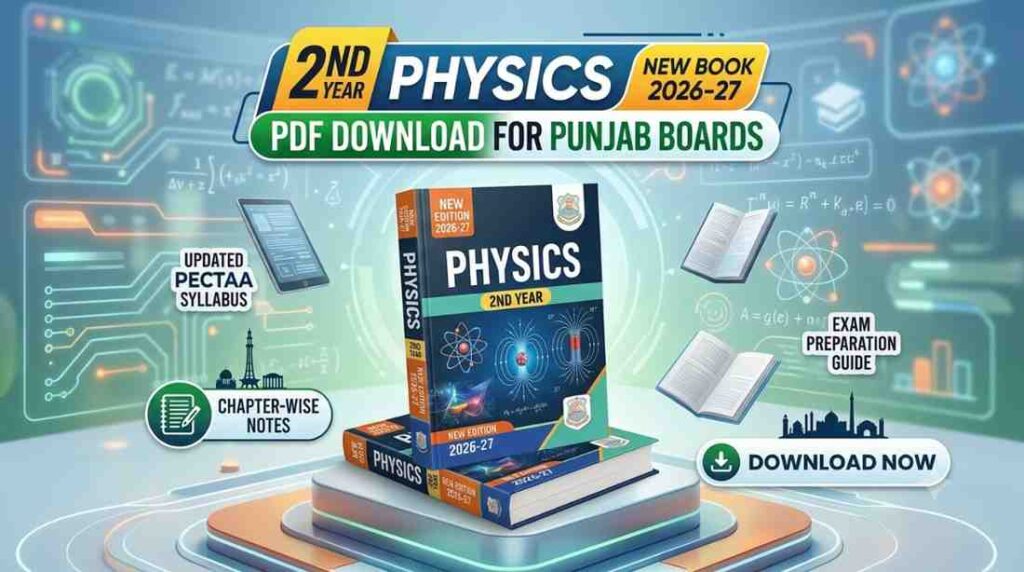
The academic year 2026-27 brings an exciting transformation for intermediate science students across Punjab with the introduction of the 2nd Year Physics New Book 2026-27. As part of the Punjab Education Curriculum, Training and Assessment Authority (PECTAA) reform initiative, this updated textbook represents a significant milestone in physics education for 12th-grade students . Following the successful implementation of new curricula for 9th and 11th grades, the 2nd year syllabus has now been modernized to meet contemporary academic standards .
This article provides a comprehensive overview of what students, teachers, and parents can expect from the updated physics textbook, syllabus structure, examination patterns, and available resources for the upcoming academic session.
Also Check: 2nd Year Mathematics New Book 2026-27 PDF – Punjab Board Syllabus & Notes
The Evolution of Physics Curriculum in Punjab
The 2nd Year Physics New Book 2026-27 is part of a broader educational reform led by PECTAA, aimed at updating educational content across all subjects . For the 2026 academic year, PECTAA has introduced a “Smart Syllabus” under the Accelerated Learning Program (ALP), which focuses on essential topics while reducing unnecessary academic burden . This initiative helps students complete core concepts within a limited time frame while maintaining academic quality and board examination standards.
The changes reflect a commitment to improving the quality of education across Punjab, with curriculum updates designed to address the evolving needs of students in today’s rapidly changing world .
Key Features of the 2nd Year Physics New Book 2026-27
The 2nd Year Physics New Book 2026-27 covers a comprehensive range of physics topics essential for students pursuing careers in science, engineering, and technology. The textbook comprises ten chapters, each focusing on fundamental physics principles :
Chapter 12: Electrostatics – This foundational chapter covers electric charges, Coulomb’s law, electric fields, electric potential, and Gauss’s law. Students learn about capacitors, dielectrics, and the energy stored in electric fields .
Chapter 13: Current Electricity – Exploring electric current, Ohm’s law, resistance, resistivity, and conductivity. This chapter also covers combinations of resistors, Kirchhoff’s laws, and applications like Wheatstone bridge and potentiometer .
Chapter 14: Electromagnetism – A crucial chapter covering magnetic fields, Oersted’s experiment, Biot-Savart law, Ampere’s circuital law, and force on moving charges and current-carrying conductors . Students learn about cyclotrons, galvanometers, and magnetic dipole moments.
Chapter 15: Electromagnetic Induction – This chapter introduces Faraday’s law, Lenz’s law, self and mutual induction, and AC generators. Eddy currents, transformers, and alternating current circuits are also covered in detail .
Chapter 16: Alternating Current – Students explore AC circuits with resistors, inductors, and capacitors. The chapter covers LCR series circuits, resonance, Q-factor, and power in AC circuits .
Chapter 17: Physics of Solids – This chapter introduces solid-state physics concepts including energy bands in solids, semiconductors, intrinsic and extrinsic semiconductors, and PN junction diodes .
Chapter 18: Electronics – Building on semiconductor basics, this chapter covers PN junction diodes as rectifiers, Zener diodes, LEDs, junction transistors, and logic gates including NOT, OR, AND, NAND, and NOR .
Chapter 19: Dawn of Modern Physics – Students explore the transition to modern physics, including the photoelectric effect, particle nature of light, and electromagnetic waves and their characteristics .
Chapter 20: Atomic Spectra – This chapter covers atomic structure, Rutherford’s atomic model, Bohr’s theory, and atomic spectra. Students learn about X-rays and the wave-particle duality of matter .
Chapter 21: Nuclear Physics – The final chapter covers nuclear properties, radioactivity, nuclear fission and fusion, and applications of nuclear physics including radio isotopes and nuclear reactors .
Availability and Accessibility of the Textbook
The 2nd Year Physics New Book 2026-27 is available in both English and Urdu medium versions to cater to diverse student needs . Students can access the textbook through multiple convenient channels:
Free PDF Downloads: The complete textbook is available for free download, ensuring accessibility for all students regardless of their location . Several educational platforms provide the 2nd Year Physics New Book 2026-27 PDF for easy access.
High-Quality Resolution: Unlike other scanned copies, the available PDFs maintain high-quality resolution, ensuring all illustrations, diagrams, and derivations are clearly visible . This is particularly important for physics, where visual understanding of concepts like electromagnetic radiation, vectors, and circuit diagrams is essential.
Chapter-wise Resources: Students can download individual chapters or the complete book, making it convenient for focused study on specific topics . The PDF format ensures compatibility with all devices.
Print Option: If hardcopies are not immediately available from bookstores, students can print downloaded chapters and use them until the physical books become available . This ensures uninterrupted studies even during supply shortages.
Examination Preparation for the 2026-27 Session
With the introduction of the 2nd Year Physics New Book 2026-27, students need to adapt their preparation strategies for the new syllabus and examination pattern :
Smart Syllabus: PECTAA has released the Smart Syllabus for the 2nd Year Annual Exams 2026, focusing on essential topics while removing unnecessary or repetitive concepts . This initiative emphasizes problem-solving skills and conceptual understanding.
Important Derivations and Definitions: The Smart Syllabus highlights key derivations, definitions, and numerical problems that require focused attention . Students should prioritize these areas for effective board exam preparation.
Comprehensive Notes: Chapter-wise study materials are available, including MCQs, short questions, long questions, derivations, and solved numericals . These resources are prepared according to the latest Punjab Board syllabus and updated for 2026.
Online Study Resources: Educational platforms now offer video lectures, live classes, and online assessments to help students prepare interactively for their final academic exams . Students can access these resources from home to enhance their learning.
Changes and Improvements in the New Edition
The 2nd Year Physics New Book 2026-27 introduces several significant improvements over previous editions:
Conceptual Focus: The new edition emphasizes conceptual understanding over rote memorization, with increased focus on problem-solving skills and practical applications .
Content Optimization: Unnecessary or repetitive concepts have been removed to make the book more streamlined and effective . This helps students focus on essential topics that carry greater weight in board examinations.
Modern Examples: The textbook incorporates updated examples and illustrations, making physics more relatable and engaging for students .
Enhanced Visual Aids: High-quality diagrams, schematics, and visual representations help students better understand complex physics concepts .
How to Make the Most of the New Textbook
To excel in physics using the 2nd Year Physics New Book 2026-27, students should adopt a strategic approach:
Download the PDF Early: Access the free PDF as soon as it becomes available to begin preparation without delay .
Understand the Smart Syllabus: Familiarize yourself with the updated syllabus and focus on topics emphasized by PECTAA for the 2026 exams .
Use Comprehensive Notes: Supplement textbook study with solved exercise solutions, derivations, and numerical problem sets .
Practice Numericals Regularly: Physics requires consistent practice. Focus on important numerical problems as highlighted in the Smart Syllabus.
Stay Updated: Follow official PECTAA announcements for any further updates or changes to the syllabus or examination format .
Attend Online Classes: Join live physics classes and use interactive learning resources to enhance understanding .
The 2nd Year Physics New Book 2026-27 represents a significant advancement in intermediate physics education in Punjab. With its modernized content, emphasis on conceptual learning, and optimized syllabus under the PECTAA Smart Syllabus initiative, this edition promises to better prepare students for their board examinations and future academic pursuits in science and engineering .
The accessibility of free PDF downloads, availability of comprehensive study resources, and the modernized curriculum make this an exciting time for physics education in Punjab . Students are encouraged to start their preparation early, utilizing the wealth of resources available online and focusing on the essential topics identified in the Smart Syllabus .
With proper planning, consistent practice, and strategic use of available resources, students can master the content of the 2nd Year Physics New Book 2026-27 and achieve excellent results in their board exams.