

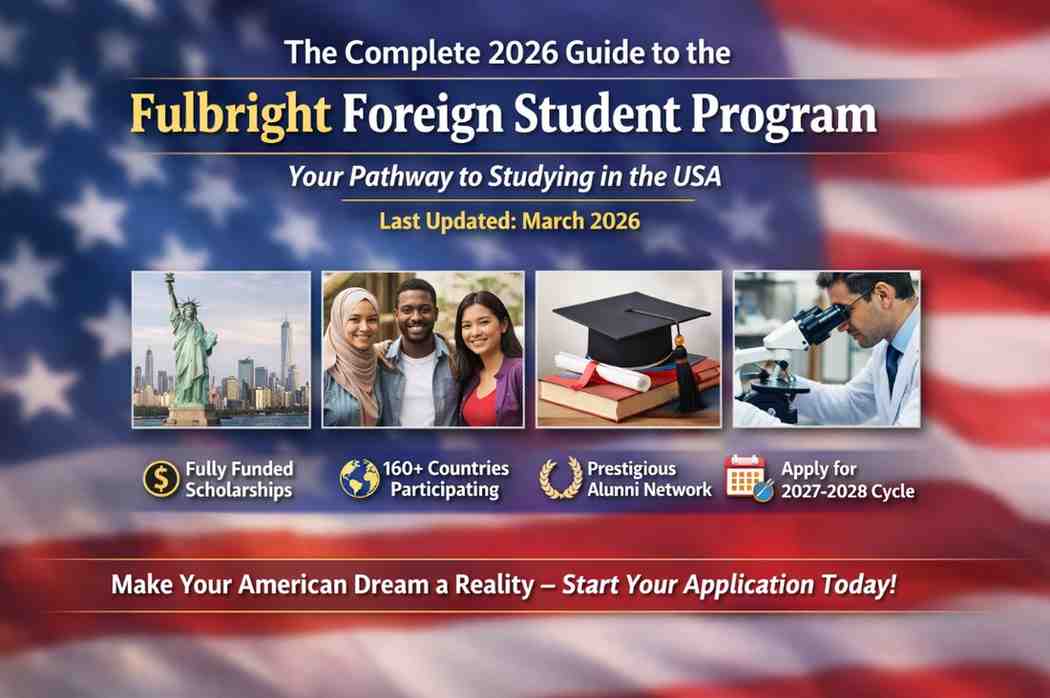
Fulbright Foreign Student Program – I remember sitting in a crowded university hall back in 2015, listening to a Fulbright scholar talk about her time in New York. She spoke about the libraries, the late-night discussions with classmates from six continents, and how she never paid a single dollar for tuition. That moment stuck with me. Today, as applications open for the 2027-2028 cycle, thousands of students around the world are feeling that same spark of possibility.
The Complete 2026 Guide to the Fulbright Foreign Student Program: Your Pathway to Studying in the USA
If you have ever dreamed of pursuing graduate studies in the United States but assumed it was financially out of reach, the Fulbright Foreign Student Program might just be your answer. It is not merely a scholarship—it is the U.S. government’s flagship international exchange program, operating in over 160 countries and designed to foster mutual understanding between Americans and people from other nations .
Let me walk you through everything you need to know about applying for the 2026-2027 cycle and beyond, including some important changes that the program has introduced recently.
What Exactly is the Fulbright Foreign Student Program?
The Fulbright Program was established in 1946 with a remarkably ambitious goal: to build peace through educational exchange. Nearly eighty years later, it has become the most prestigious academic exchange program in the world.
Unlike typical scholarships that simply write a cheque to your university, Fulbright takes a holistic approach. Selected students—often called “Fulbrighters”—receive comprehensive support including tuition, airfare, living stipends, and health insurance . But more importantly, they become part of a global network of alumni that includes 61 Nobel Prize winners, 89 Pulitzer Prize recipients, and 40 former heads of state.
For the 2027-2028 academic year, the Fulbright Foreign Student Program is accepting applications across multiple categories, including master’s degree study, doctoral research, and even specialized professional programs .
Key Dates You Cannot Afford to Miss (2026-2027 Cycle)
One of the most confusing aspects of the Fulbright application is that deadlines vary significantly by country. Here is what the current application landscape looks like:
| Country | Program Cycle | Application Deadline | Key Notes |
|---|---|---|---|
| Zimbabwe | 2027 | April 30, 2026 | Priority for agriculture, AI, digital transformation |
| Kenya | 2027-2028 | April 20, 2026 | Master’s and Visiting Scholar programs open |
| Pakistan | 2027 | April 1, 2026 | Sciences, AI, economics encouraged |
| Côte d’Ivoire | 2026-2027 | April 10, 2026 | TOEFL iBT 90 or Duolingo 110 required |
| Lebanon | 2026 | May 5, 2025 | Currently closed for 2026 cycle |
| Philippines | 2026-2027 | Closed | Check back for 2027-2028 announcements |
| Switzerland | 2027-2028 | August 2026 | Applications open mid-2026 |
| UAE | 2027 | Open now | Apply via Amideast website |
Important Note: The program you apply for (for example, “2027 Fulbright”) typically means you would begin your studies in the fall of 2027. The application process itself takes place roughly 18 months before your departure .
What Does the Scholarship Actually Cover?
Let’s talk money, because this matters. The Fulbright Foreign Student Program is fully funded, meaning you should not have to pay out of pocket for your education. Based on current country-specific announcements, here is what you can expect:
Tuition and Required Fees: Full coverage for the duration of your program (typically up to two years for a master’s degree)
Monthly Living Stipend: Enough to cover reasonable housing and food costs in your U.S. city
Round-Trip Airfare: Travel to and from the United States at the beginning and end of your program
Health Insurance: Limited accident and sickness coverage for the grant period
Book and Supplies Allowance: Because graduate textbooks are surprisingly expensive
For Swiss applicants, the grant amount is approximately $20,000 for one academic year for students, and around $43,000 for visiting scholars . Amounts vary by country and cost of living at your placement university.
Also Check: Fully Funded Scholarships in USA for International Students in 2026-27
Am I Eligible? Let’s Find Out.
Eligibility requirements are fairly consistent across countries, though there are some variations. Generally, you must:
Basic Requirements
Be a citizen of the country where you are applying (not just a resident)
Hold a bachelor’s degree or equivalent by the program start date
Have a strong academic record (most successful applicants have GPAs equivalent to A-/B+ or higher)
Demonstrate English proficiency through TOEFL, IELTS, or Duolingo
The “Home Residency” Requirement
Here is something crucial: Fulbright requires that you return to your home country for at least two years after completing your program. This is tied to the J-1 visa you will receive. You cannot simply stay in the U.S. after graduation—the program is designed for you to bring your knowledge back home .
Who Typically Gets Preference?
Applicants with little or no recent U.S. experience
Candidates committed to public service or community development
Those with two or more years of professional work experience (required for MBA applicants in some countries)
Who Cannot Apply?
U.S. citizens, green card holders, or dual citizens
Current U.S. embassy employees and their immediate families
Recent Fulbright recipients (usually within the last five years)
Fields of Study: What Can I Actually Study?
The short answer: almost anything, with a few exceptions. The Fulbright Foreign Student Program is particularly interested in candidates working on global challenges.
Encouraged Fields for 2026-2027
Based on embassy announcements from multiple countries, there is growing interest in:
Artificial Intelligence and Digital Transformation
Science, Technology, Engineering, and Mathematics (STEM)
Public Health (non-clinical)
Economics, Trade, and Business
Environmental Studies and Climate Change
American Studies and International Relations
Restricted Fields
Most embassies explicitly exclude:
Clinical medicine, nursing, and dentistry
Veterinary medicine
Physical and occupational therapy
Clinical psychology
The rationale is that these clinical fields require extensive hands-on training that is difficult to accommodate within the program structure. Fulbright Foreign Student Program
The Application Process: A Step-by-Step Roadmap
Applying for Fulbright Foreign Student Program is not something you do in a weekend. Successful applicants typically spend months preparing. Here is what the journey looks like:
Step 1: Create Your Account
Most countries use the centralized application portal at apply.iie.org/ffsp2027 (for the 2027 cycle) . Make sure you select the correct award for your country.
Step 2: Gather Your Documents
You will need to upload:
Academic transcripts from every post-secondary institution attended (translated into English if necessary)
Three letters of recommendation from professors or employers who know you well
A personal statement (usually around 600 words) explaining who you are and why you want this opportunity
A study/research objective outlining what you plan to study and why it matters
Your CV or résumé detailing education, work experience, and achievements
Step 3: Take Standardized Tests
Most applicants need:
TOEFL iBT (minimum 80-90) or IELTS (minimum 6.5) or Duolingo (minimum 110)
GRE for most fields
GMAT for business school applicants (minimum 550 for master’s, 600 for doctoral in some countries)
Pro Tip: In many countries, you should not register for these tests independently before being shortlisted. The U.S. embassy often provides testing vouchers to semi-finalists, saving you hundreds of dollars .
Step 4: Submit Before the Deadline
Deadlines are strict. Incomplete applications are simply not considered . Give yourself at least a week before the deadline to handle any technical glitches.
Step 5: Interview (If Shortlisted)
If selected as a semi-finalist, you will be invited for an interview at the U.S. embassy or a partner organization like Amideast. These interviews typically happen in May or June .
Common Mistakes That Get Applications Rejected
Over the years, I have seen brilliant candidates miss out because of avoidable errors. Here are the pitfalls to avoid:
Missing the deadline. It sounds obvious, but it happens every year.
Submitting incomplete documents. Check the list three times.
Ignoring eligibility restrictions. If the program requires two years of work experience and you have 18 months, do not apply. You will be automatically disqualified.
Generic essays. “I want to change the world” is not enough. Be specific. Show, don’t tell.
Weak letters of recommendation. Choose referees who actually know you, not just famous professors who barely remember your name.
Ignoring the home residency requirement. If you are not prepared to return home for two years, this program is not for you .
Registering for tests too early. Wait for embassy guidance on vouchers .
Frequently Asked Questions
Can I apply if I am already studying in the United States?
Generally, no. The program is designed for candidates residing in their home countries. Dual citizens or U.S. permanent residents are also ineligible .
What is the success rate?
It varies by country, but Fulbright is extremely competitive. In Pakistan, over 3,000 students have received scholarships since 2005, but thousands apply each year .
Do I need to find a U.S. university before applying?
No. The Institute of International Education (IIE) provides placement services for selected candidates, matching you with appropriate U.S. universities .
Can I bring my family?
Generally, the grant is for the scholar only. Dependent support is not typically provided, though regulations vary by country.
What if my English is not perfect?
Some candidates with strong profiles but slightly lower English scores may be eligible for the Long-Term English (LTE) Program, which provides up to eight months of language training before academic studies begin .
Final Thoughts: Is Fulbright Right for You?
The Fulbright Foreign Student Program is more than a scholarship. It is a commitment—to academic excellence, to cross-cultural understanding, and to returning home to make a difference. The application process is demanding, and the competition is fierce. But for those who succeed, it opens doors that remain closed to almost everyone else.
As you prepare your application, remember what USEFP Executive Director Dr. Peter Moran said: “The Fulbright Program has empowered thousands of students to fulfill their dreams of studying at U.S. institutions, which are known for their academic excellence and innovative research opportunities” .
If you have the grades, the vision, and the determination, start your application today. Visit your local U.S. embassy website or the central application portal at apply.iie.org. Your American dream might be closer than you think.
Have you applied for the Fulbright Foreign Student Program before? Share your experience in the comments below—your story might inspire the next generation of scholars.





Leave a Reply